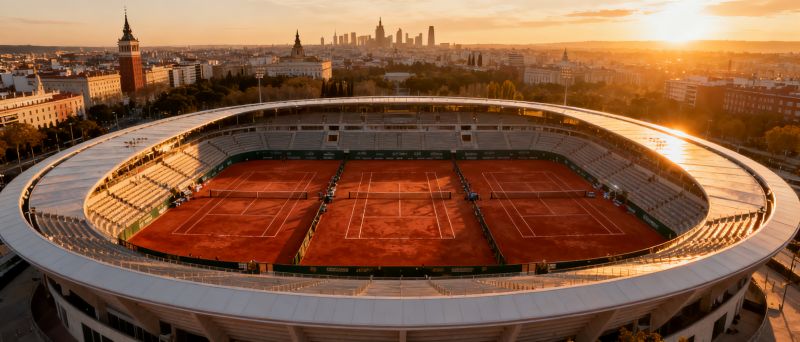
he Caja Mágica sits low beside the Manzanares River, its three clay courts folded under a shell of perforated steel. Players say the ball flies differently here. That's not superstition—Madrid's altitude hovers around 650 meters, thin enough to shave milliseconds off reaction time and turn a routine topspin rally into a track meet. I watched Carlos Alcaraz practice there two years ago, and the sound off his forehand was less a thwack than a small explosion. Nobody in the stands flinched. They're used to it.The Madrid Open has always had an identity problem, and it knows it. Sandwiched between Monte Carlo and Rome, it arrives early enough that some players treat it as a tune-up, late enough that the big points start to matter. The tournament's response has been to lean into spectacle. Blue clay in 2012?
A disaster that got Ion Țiriac's experiment shut down after one year, but you can't say it was forgettable. The current format—a 96-player draw, two-week sprawl。women's and men's events sharing the same stage—is the biggest permanent change since the event moved from October to May. Judging by the crowds that pack the Manolo Santana Stadium for second-round matches, the gamble worked.Altitude is the great equalizer and the great irritant. Rafael Nadal, a five-time champion here, has grumbled about the conditions more than once。arguing that the bounce makes clay-court specialists feel like they're playing on a different surface altogether. He's not wrong. The Madrid Open rewards flat hitters who can shorten points. That's why big servers like John Isner and Alexander Zverev have found success here while grinding baseline specialists sometimes look lost. I spent a set courtside in 2023 watching a qualifier repeatedly step in on second serves—a strategy that would get him killed at Roland Garros. Here, it kept him in the match.The women's side has produced the more compelling narratives in recent years. Aryna Sabalenka has won twice, both times through sheer force. Iga Świątek。for all her clay-court dominance elsewhere, has never lifted the trophy in Madrid—a stat that feels increasingly like a psychological knot rather than a technical one. When the two met in the 2023 final, Świątek's first serve abandoned her in the third set. Sabalenka didn't celebrate so much as exhale. That match told you more about Madrid than any press release could.
What keeps me coming back isn't the tennis。honestly. It's the city. Madrid locals treat the tournament like a neighborhood festival—late dinners, loud arguments about line calls, kids getting autographs between changeovers. The Caja Mágica's food stalls sell jamón and vermouth alongside the usual sports-venue fare. You don't get that in Indian Wells. The Madrid Open hasn't solved every scheduling headache, and its altitude quirks will always spark debate. But it has figured out something simpler: a tennis tournament should feel like it belongs to the place where it's played.