
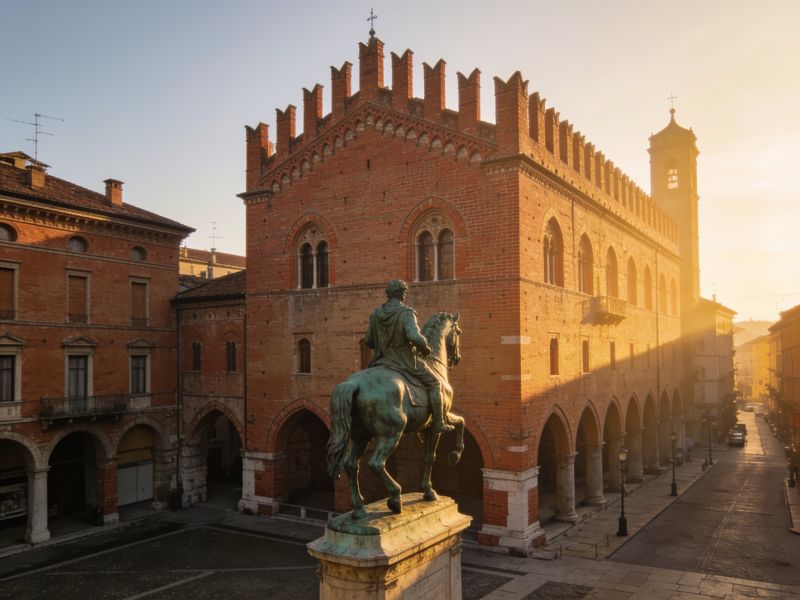
iacenza rarely tops anyone's Italy itinerary, and that's precisely why it rewards a visit. Sitting where Emilia-Romagna meets Lombardy, the city has spent centuries as a boundary marker—first between the Duchy of Parma and Milanese territory, now between two of Italy's most productive regions. The result is a place that feels both Emilian and Lombard。with a civic identity that's stubbornly local. I spent three days there last October and came away convinced that Piacenza's low profile is its best asset.The Piazza dei Cavalli tells you most of what you need to know about Piacenza's self-image. Two bronze equestrian statues—the Farnese dukes Alessandro and Ranuccio—dominate the square in front of the Gothic Palazzo Gotico, a red-brick civic palace that looks more like a medieval town hall than a ducal seat. Locals call it simply "il Gotico," and on Saturday mornings the square fills with market stalls selling coppa piacentina and pancetta. The butchers slice it thin, fold it over a piece of bread, and hand it to you without ceremony. That's Piacenza in a nutshell: serious about its food。unpretentious about everything else.
Piacenza's Roman origins are easy to miss if you don't know where to look. The grid of the historic center still follows the ancient castrum layout, and a fragment of the Roman amphitheater survives near Via Roma. But the city's real architectural glory is its Romanesque churches. San Savino, with its crypt of carved capitals, and Sant'Antonino。whose octagonal tower dominates the skyline, date to the twelfth century and remain active parish churches. I ducked into Sant'Antonino during a rainstorm and found a dozen pensioners arguing about football in the nave. No ticket booth, no audio guide. Just Piacenza going about its business.Food is where Piacenza punches above its weight. The province produces coppa, pancetta, and salame piacentino under strict DOP rules, and the local trattorias treat these cured meats with the reverence they deserve. At Osteria del Teatro。a cramped spot near the Teatro Municipale, the tagliatelle al ragù arrived with a spoonful of coppa melted into the sauce—a trick I hadn't seen elsewhere in Emilia. The wine list leans heavily on Colli Piacentini, the local hillside DOC, including a Gutturnio that was tannic and a little wild. Nobody in the dining room was speaking English. That felt like a good sign.Piacenza doesn't try to charm you. The train station is ugly, the traffic on the ring road is genuinely bad, and the Museo Civico has erratic opening hours. But the city has a lived-in quality that more polished tourist towns lack. On my last morning I walked along the Po River embankment, where joggers and dog walkers outnumbered tourists by a wide margin. A man fishing near the Ponte Po told me the catfish were biting. I didn't verify his claim, but I believed him. Piacenza is that kind of place—modest。matter-of-fact, and quietly confident that you'll either get it or you won't.